It is the first week of December. Your feed fills with the same thing, over and over. Friends posting a tidy little card of their most-played songs, their top artist, the minutes they spent listening this year.
Nobody was paid to post it. Nobody was asked. They just did, in their millions, all in the same few days.
That is Spotify Wrapped, and it is the closest thing modern marketing has to a sure thing. Every December the same brand gets a free wave of attention that most companies would burn a quarter’s budget to buy once.
Here is what most marketers get wrong about it. They look at Wrapped and see a clever data feature. It is not.
It is a distribution machine built on one insight about why people share. In this deep-dive we will pull the Spotify Wrapped marketing campaign apart, correct the assumptions that stop other brands copying it, and show what actually transfers to a business that is not Spotify.
The Spotify Wrapped marketing campaign in numbers
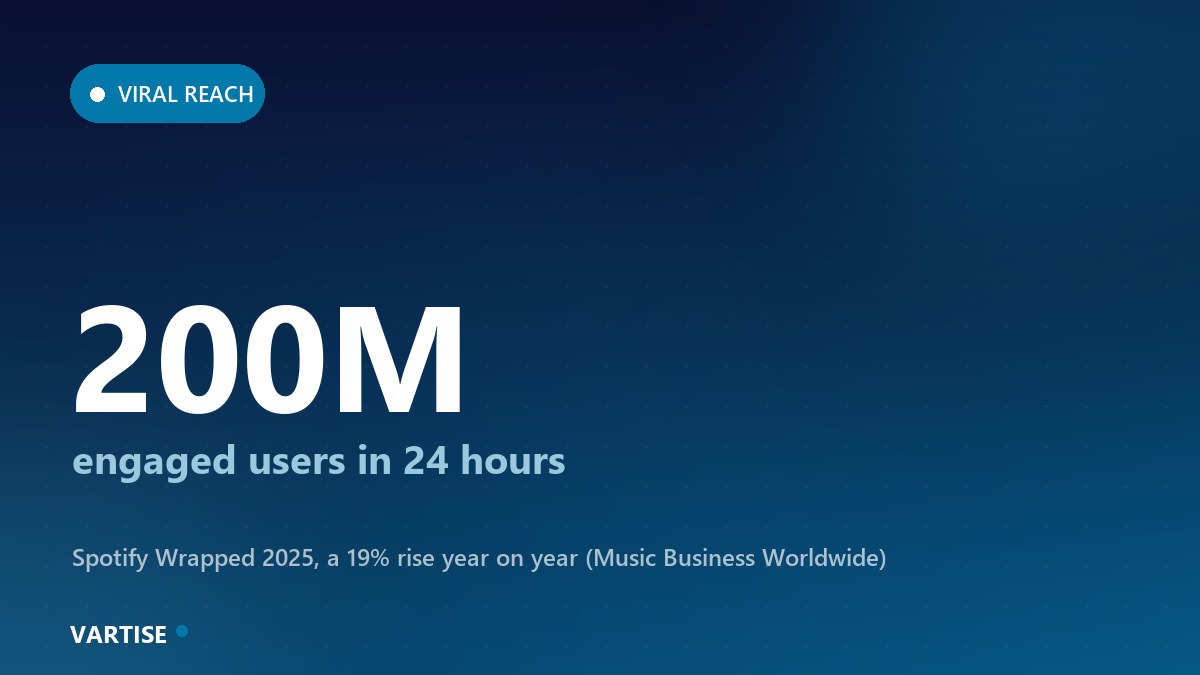
Start with the scale, because the scale is the argument. The 2025 edition reached 200 million engaged users within roughly 24 hours of launch, a 19% rise on the year before, according to Music Business Worldwide. The year before, hitting that same number took 62 hours.
Sharing grew even faster. The same campaign drove around 500 million shares, up 41% year on year. Spotify’s own numbers put the full run at more than 300 million engaged users and 630 million shares across social media, in 56 languages.
The business result is not soft, either. Spotify closed the quarter with a record 751 million monthly active users, up 11% year on year, adding 38 million new users in Q4, reported by TechCrunch. Spotify credited Wrapped, alongside new free-tier features, as a primary driver of that surge.
Those figures look like a music-industry story. They are not. They are a playbook, and the rest of this article is about reading it correctly.
The first step is to throw out the assumptions that keep most brands stuck.
Misconception one: Wrapped works because of the data
Almost every brand that tries to copy Wrapped starts in the wrong place. They start with the data they hold. They build a report, dress it up, and wait for the shares that never come.
The data is not the point. Spotify has tracked listening since day one, and so does every rival. What Wrapped does is turn that data into a story about the person, not about the platform.
Your top artist, your minutes, your taste. The user is the hero of every single card.
We have seen this trip up clients more than once. They confuse “we have data” with “we have something people want to post”. Nine times out of ten the problem is not the dataset, it is the framing.
A dashboard is information. A flattering, specific story about you is a reason to hit share.
This is the difference between data you report and data you give back. If you want the mechanics of turning numbers into something a customer feels, our guide to the marketing metrics that predict growth covers which numbers are worth surfacing at all. The next misconception is about who does the sharing, and why.
Misconception two: it goes viral by luck
People call Wrapped a viral hit, as if virality happened to it. It did not. The campaign is engineered to spread, and the engineering is repeatable.
The drop is timed so everyone shares at once
Wrapped lands on a fixed window in early December, every year, for everyone. That synchronisation matters. When your whole network gets it on the same day, sharing yours feels normal, even expected.
A staggered rollout would kill the wave. The shared moment is the engine.
Every card is built to be screenshot-ready
The visuals are vertical, bold, and sized for a phone screen and a Story. There is no friction between seeing your result and posting it.
Spotify even adds a share button that pre-formats the card for Instagram and TikTok. The product does the design work the user would otherwise skip.
FOMO does the recruiting
If your friends are all posting Wrapped cards and you cannot, you feel left out. That is the recruitment loop. Non-users see the cards, want their own, and download the app.
This is the same mechanic behind the Ice Bucket Challenge, where seeing peers take part was the whole invitation. Engineered virality is not luck, it is design choices stacked on each other.
That leads to the misconception that hurts smaller brands most.
Misconception three: you need Spotify’s scale to do this
This is the one that stops good ideas dead. A marketing manager looks at 630 million shares and decides the whole model is out of reach. It is not.
The mechanic scales down cleanly.
The principle is simple. Take data you already hold about a customer, give it back as a personal story, and make it easy to share.
You do not need hundreds of millions of users. You need a moment a customer wants to show off.
Plenty of smaller brands run their own versions. Reddit Recap, Strava’s Year in Sport, Duolingo’s year-end stats, and banking apps that show “your year in spending” all borrow the same move.
None of them have Spotify’s audience. All of them get shares because the format does the work.
| Year | Wrapped result | Source |
|---|---|---|
| 2023 | Over 2 billion impressions; 90M+ users shared their stats | NoGood / industry reporting |
| 2024 | 200M engaged users reached in ~62 hours | Music Business Worldwide |
| 2025 | 200M engaged users in ~24 hours; ~500M shares (+41% YoY) | Music Business Worldwide |
| Q4 2025 | 751M monthly active users; 38M new users added | TechCrunch |
The table makes the point clearly. The reach keeps climbing because the format compounds, not because the audience suddenly tripled.
What transfers to your brand is the format, and that is where most teams need a plan rather than a guess. A sharp social media strategy starts by finding the one piece of customer data worth handing back.
What actually transfers to your brand
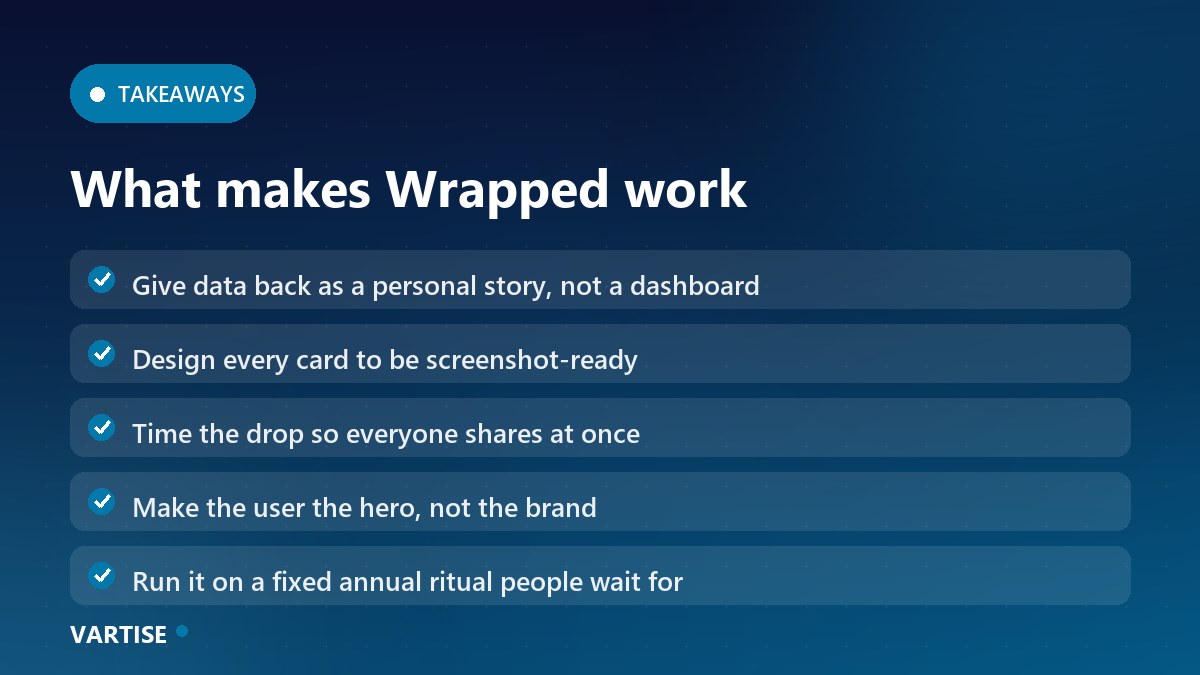
So strip Wrapped down to the parts you can use. Most clients come to us wanting “a viral campaign”. What they actually need is a sharable artefact and a reason to share it on cue.
Make the customer the hero
The post is about them, never about you. Your logo sits in the corner, quiet. The flattering, specific result is the headline.
If the artefact reads as a brand ad, nobody shares it.
Pick one number that flatters
You do not need a year of data. You need one figure a customer is proud of. Steps walked, books finished, money saved, projects shipped.
One number, framed as an achievement, beats a full report every time.
Remove every step between seeing and sharing
Pre-format the image for the platform. Add the share button. Design for the phone first.
Friction is where shares die, so design the moment, not just the data. Building that kind of repeatable, owned audience moment is the same muscle behind a genuinely engaged community, where people show up because they want to.
With the principles clear, it helps to be honest about where this can go wrong.
The risk most case studies skip
Wrapped sits on personal data, and that is not free of risk. The campaign works because users feel the data is theirs and the story is flattering. Cross either line and the same mechanic turns against you.
The trust line is sharp. People accept a brand showing them their own listening. They react badly to a brand exposing something they did not expect it to know.
The UK’s data regulator, the Information Commissioner’s Office, is clear that using personal data needs a lawful basis and reasonable expectations. A year-in-review only works if customers would expect you to hold what you are showing them.
The tone line matters just as much. Spotify keeps Wrapped celebratory. A “year in spending” that reads as a lecture, or a fitness recap that shames, gets shared for the wrong reasons.
The feeling has to be pride, not exposure. Get the ethics and the tone right, and you have a campaign people choose to spread. Get them wrong, and you have a privacy story you did not want.
Conclusion
Spotify Wrapped is not magic and it is not just for giants. It is a simple loop done with discipline. Take data the customer already trusts you with, hand it back as a flattering story, design it to share in one tap, and drop it when everyone gets it at once.
The data is the fuel. The story and the timing are the engine.
Any brand can run a version of this, at any size, if the customer is the hero and the moment is built with care. If you want help finding the one piece of data worth handing back and turning it into something people post, our digital marketing team can map it with you.
Frequently asked questions
What is the Spotify Wrapped marketing campaign?
Spotify Wrapped is an annual campaign, run every December since 2016, that turns each user’s listening data into a personalised, shareable summary of their year. It shows top songs, top artists and minutes listened in a phone-ready format designed to be posted on social media, which spreads the brand for free.
Why does Spotify Wrapped go viral every year?
It is engineered to spread, not lucky. The drop is timed so everyone receives it at once, the cards are built to be screenshot-ready, and seeing friends post creates fear of missing out that recruits new sharers. The story is about the user, so people share it as self-expression rather than as an advert.
Can a small business copy the Spotify Wrapped model?
Yes. You do not need Spotify’s scale, only data you already hold and a story worth posting. Pick one flattering number, give it back to the customer as an achievement, design it for the phone, and make sharing a single tap. Brands like Strava and Duolingo run smaller versions of the same idea successfully.
How many people share Spotify Wrapped?
The 2025 campaign drove around 500 million shares, a 41% rise year on year, and reached 200 million engaged users within about 24 hours, according to Music Business Worldwide. Spotify’s wider figures put the full run at more than 300 million engaged users and 630 million shares across 56 languages.
What data privacy issues does a year-in-review campaign raise?
Showing customers their own data only works if they expect you to hold it and the tone is positive. Under UK GDPR you need a lawful basis to process personal data and must respect reasonable expectations, as the ICO sets out. Keep the summary celebratory and limited to data customers knowingly gave you.